
Chickasaw Regional Release Paths
Chickasaw County Regional Correctional Facility holds people under more than one legal authority. A county detainee may leave on bond, recognizance, dismissal, credit for time served, or completion of a local sentence. The person may instead be sent to another county, MDOC, a federal authority, or ICE. Only the first group has plainly returned to the community. The facility booking and release entry should show the physical exit time, release type, authority, and any receiving agency that is public.
An MDOC prisoner housed at the same Houston facility follows a different path. State exits include parole, Earned Release Supervision, maximum discharge, conditional medical release, transfer to another MDOC unit, or surrender to another authority. A Chickasaw location label does not turn that state record into a county booking. The strongest proof combines the updated MDOC record with a discharge certificate or Community Corrections status. If parole is involved, the Parole Board action explains the decision, but MDOC still must carry out the release.
| Exit shown | What it means | Best confirmation |
|---|---|---|
| Bond or time served | County custody ended under a court or jail authority | Facility release entry and court order |
| Parole or ERS | MDOC confinement ended, but supervision continues | MDOC status, discharge document, and Community Corrections |
| Maximum discharge | The MDOC sentence reached its calculated end | Discharge certificate and MDOC record |
| Transfer | Custody moved to another agency or institution | Movement entry and receiving-agency record |
Confirm Chickasaw Facility Releases
Begin with identifiers, not a photograph. A full name, date of birth, booking number, court case number, or MDOC ID helps separate people with similar names. Then decide whether the person entered only county custody or served an MDOC sentence. The complete county-wide sequence is also set out on the Chickasaw County released inmate search.
- Ask the facility whether the record is a county booking or an MDOC placement. Request the booking number or MDOC ID tied to the person.
- For a county case, request the release date and time, type, authority, and transfer destination when releasable. Match those fields to the correct Circuit, Justice, or Municipal Court case.
- For an MDOC sentence, use the official offender search. Compare identity, sentence, county of conviction, unit, and tentative release fields.
- Look for a positive event. A county release entry, MDOC discharge certificate, or community-supervision status is stronger than absence from a current list.
- If another authority received the person, continue with that authority. A move to MDOC, another county, BOP, or ICE is not community release.
A name disappearing from the Chickasaw facility is not proof of release. Transfer, court movement, data delay, or an identity mismatch can produce the same result.
Chickasaw Release Records Contact
The official MDOC facility profile is the verified source for the regional facility address and main phone. Call first to identify the custodian of the county booking database. The Sheriff’s Department has a separate administrative address next door, and the research found no published local records form, records-unit hours, or fixed fee schedule.
Chickasaw County Regional Correctional Facility120 Lancaster Circle
Houston, MS 38851
Phone: 662-456-3319
Ask for an existing record rather than a new explanation. A narrow request should name the person, booking number if known, and a short date range. Seek the booking and release entries, release authority, court case number, transfer field, and booking photograph if disclosable. If staff directs the request to the Sheriff’s Department, use 130 Lancaster Circle, Houston, MS 38851, and 662-456-2339. Confirm the current submission method before sending sensitive identifiers.
Mississippi Public Records Act guidance explains access to nonexempt public records under Title 25, Chapter 61. A custodian may redact juvenile, medical, victim, security-sensitive, investigative, sealed, or expunged material. When a field is withheld, ask for the legal basis and for a segregable copy of the rest. No verified Chickasaw County price or retention period should be assumed.
Chickasaw Regional Custody Types
MDOC describes Mississippi regional facilities as county-sheriff operations working under agreements with the state corrections department. The 2026 PREA audit identifies the Chickasaw County Sheriff’s Department as the operating agency and MDOC as the governing or parent authority. That mixed structure is not a minor label. It determines who owns the sentence data, which release calculation applies, and which office can confirm the executed event.
- County detainee
- A person held before trial or on a local sentence whose booking and physical release are recorded by the county facility.
- MDOC prisoner
- A person serving a state sentence. MDOC controls sentence calculation even when the person is housed at Chickasaw.
- Parole
- Conditional release granted by the Mississippi State Parole Board and supervised by MDOC Community Corrections.
- ERS
- Earned Release Supervision, a conditional MDOC release under which offender status and state jurisdiction continue.
- Detainer
- A request or legal hold that can cause another authority to take custody when the first stay ends.
Location and jurisdiction must stay separate. Someone convicted in Chickasaw County may be housed elsewhere in Mississippi. Someone housed at the regional facility may have been convicted in another county. Use “housed at,” “convicted in,” and “released by” only when the official fields support each statement.
View Chickasaw Facility Records
The state’s Chickasaw regional facility page shows the official profile used to route a release inquiry.
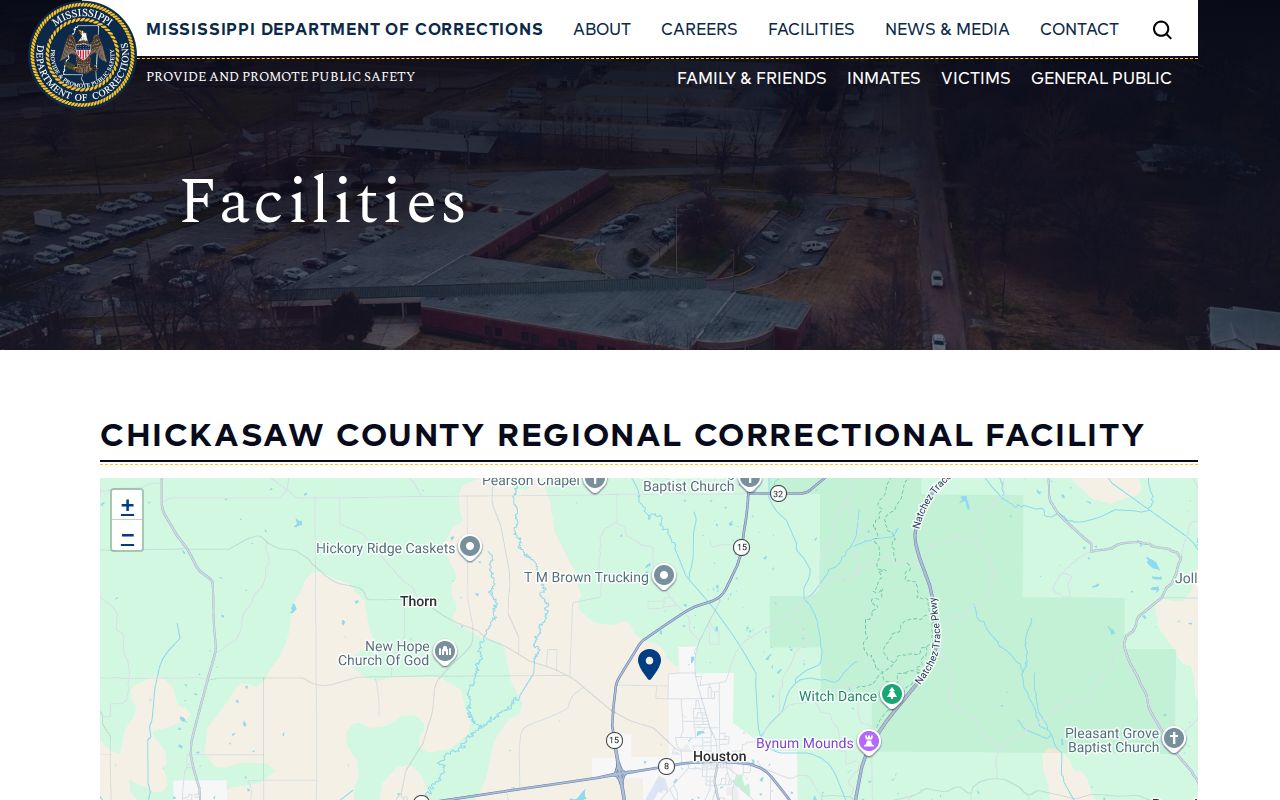
The page is a contact source, not a 24-hour roster, 72-hour list, photo archive, or release log. The phone and written-record route therefore remain essential.
Chickasaw Release Court Records
A county release entry says when staff carried out the exit. The court file explains the legal basis. Chickasaw County has Houston and Okolona court contexts, so the correct clerk depends on the case and judicial district. Use the court and case number printed on the booking or order. Do not route a criminal disposition to Chancery Court merely because the county appears in the Fourteenth Chancery District.
Mississippi Electronic Courts can provide an electronic path where the specific trial court and case participate. Otherwise, ask the proper Circuit, Justice, or Municipal Court clerk for the docket, bond order, final disposition, sentence, credit for time served, dismissal, revocation, or amended order. A dismissal may occur after an earlier bond release, and a sentence marked time served still needs the facility timestamp to show when the door opened.
Sealed or expunged records may no longer be visible. That absence does not prove there was no arrest or release. Respect the court order and request only material the custodian may lawfully disclose.
Chickasaw MDOC Release Proof
For a state prisoner, the public MDOC detail can show identity data, an MDOC number, location, sentence information, county of conviction, and a tentative release date. Tentative means expected after current credits and rules. It is not an appointment or proof the person left. A unit change can also occur without any release.
MDOC’s family guidance says the release process may take 30 to 45 days and a discharge certificate is required before release. A case manager verifies the date and travel plan. Parole and ERS dates are not guaranteed because address approval, detainers, court action, conduct, and time computation can change the outcome. For a person moving to supervision, confirm the new status through Community Corrections as well as the discharge document.
Personal funds are provided after an MDOC release. If the person transfers to another facility, the funds follow instead. That detail helps distinguish a genuine state discharge from a movement inside custody, but it does not establish the property procedure for a county bond-out.
Note: MDOC discharge rules apply only to state prisoners and should never be generalized to each local detainee leaving the Chickasaw facility.
Chickasaw Release or Transfer
No federal prison or ICE detention center was identified in Chickasaw County. Those systems still matter when a local release is a handoff. A transfer field naming a federal authority or ICE means the regional facility ended its custody, not that the person entered the community. Continue the check with the receiving agency.
The BOP Inmate Locator covers sentenced federal prisoners and many former prisoners from 1982 forward. “Released” or “Not in BOP custody” ends only BOP custody. The ICE detainee locator can include some people released from ICE within the prior 60 days, yet a missing result remains uncertain. Federal pretrial detention may instead require the court detention order and the relevant U.S. Marshals district because USMS has no general historical public locator like BOP.
Each system proves only its own event. The Chickasaw release entry, receiving-agency record, and court order must agree before a transfer is described as a community release.