
Chickasaw Parole and Probation
Mississippi divides the work among several authorities. The Mississippi State Parole Board decides whether an eligible state prisoner receives parole. The Mississippi Department of Corrections Division of Community Corrections then supervises parolees, probationers, people on Earned Release Supervision, and other approved community placements. A judge imposes probation. That difference identifies the best source: a Board record helps explain a parole decision, while the sentencing court explains probation.
Chickasaw County adds a key jurisdiction check. The regional correctional facility can house both local detainees and MDOC prisoners. A county defendant released on probation may have only a court and local supervision trail. An MDOC prisoner released on parole or ERS should have an MDOC ID, a state record, and a Community Corrections status. A facility move is not community release, and a county of conviction is not proof that the person is supervised in that county.
| Status | Who authorizes it | Best verification path |
|---|---|---|
| Parole | Mississippi State Parole Board | MDOC record, Parolee Search, Board action sheet, and supervising office |
| Probation | Sentencing court | Judgment or docket plus Community Corrections confirmation |
| ERS | MDOC under state law | MDOC time computation, approved status, and Community Corrections record |
| Full discharge | Sentence reaches its legal end | Discharge certificate or final agency and court records |
- Parole
- Conditional release from prison after a Board grant.
- Probation
- A court-ordered community sentence or condition that may not follow prison.
- ERS
- Earned Release Supervision, a conditional MDOC status outside the institution.
- Discharge
- The documented end of the sentence or supervision term.
Verify Chickasaw Post-Release Supervision
Start with a firm identity match. A name alone can lead to the wrong person. Use an MDOC ID when one exists, then compare date of birth, county, offense, and location fields. The general MDOC inmate search helps determine whether the record shows an institution or a community status. For a person thought to be on parole, the distinct MDOC Parolee Search is more direct.
- Identify whether the case is county probation, MDOC parole, ERS, or another supervision type.
- Search the MDOC record and note the MDOC ID, current location or status, sentence data, and county of conviction.
- Use the MDOC Parolee Search with the name or ID and, when useful, the Chickasaw County filter.
- For probation, compare the sentencing judgment or current court docket with the state supervision result.
- Contact the assigned Community Corrections office to confirm the limited status information it can lawfully provide.
- If parole was considered, request the named person’s hearing status or action sheet from the Parole Board.
A no-hit requires care. It may mean the person is not on parole, uses a different name entry, reports through another county, has moved under the Interstate Compact, is still confined, or has reached discharge. It does not prove that no sentence or supervision record exists. The broader Chickasaw County released-inmate search paths explain how to reconcile a release entry with the court and custody record.
Note: Community status confirms conditional release from an institution, but it does not by itself show that the full sentence is discharged.
Chickasaw Parolee Search Fields
The separate parole search is a strong local tool because Chickasaw County appears as a filter. Search inputs include first name, last name, MDOC ID, city, and county. Results may show an ID number, name, location, offense, and a link to more detail. The detail template can add county, supervising officer, Flat Time Date, a photograph, and identity descriptors.
Read those fields as parts of one supervision record. “Location” may identify a Community Corrections assignment, not a residence or the place of conviction. A Flat Time Date is a sentence-computation field, not a promise that all duties end that day. The photograph can aid comparison, but a face is not enough for a conclusive match. Confirm through the record number and official office.
The MDOC supervision overview also distinguishes probation, parole, intensive supervision, interstate cases, and ERS. That context matters when two results look alike. A parole record answers a narrower question than the general offender search and should not be treated as a list of all released Chickasaw County detainees.
The official MDOC supervision page below shows the state framework used to interpret a Chickasaw County community-status record.
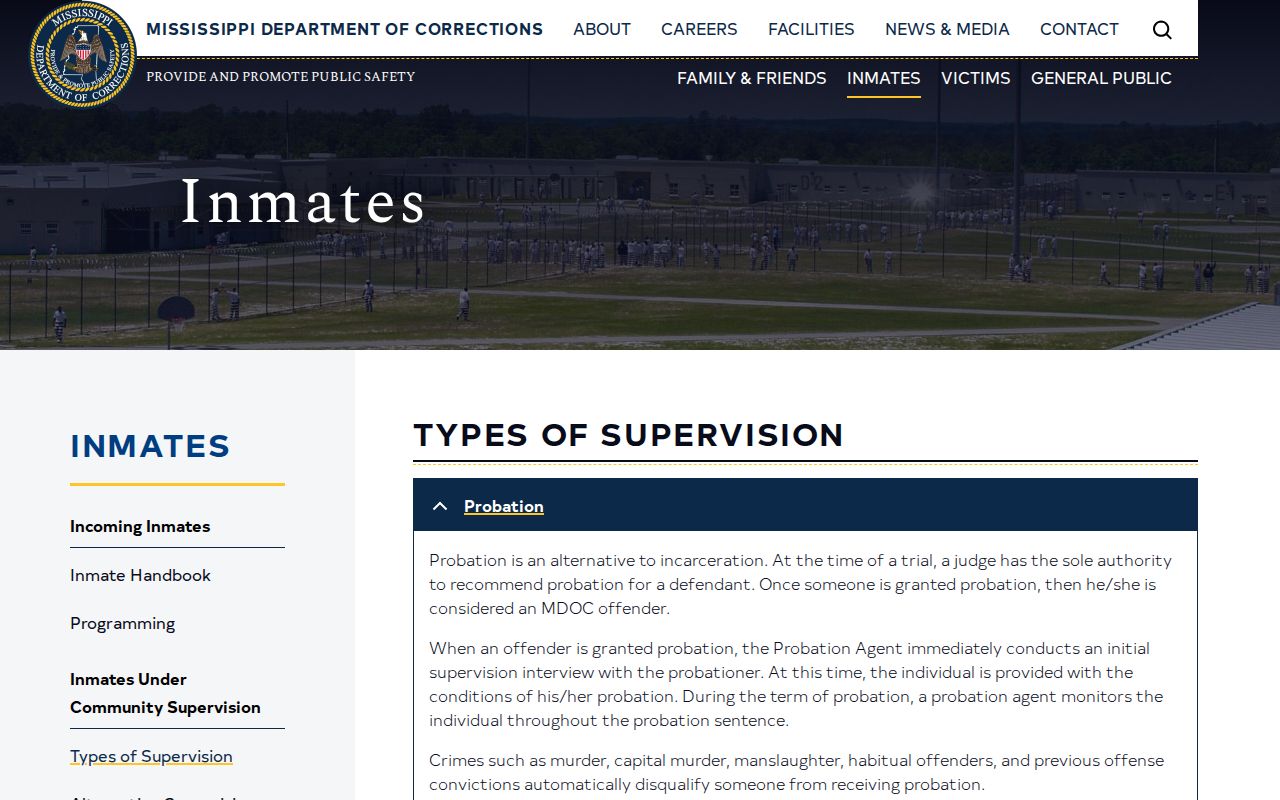
Its categories help separate a conditional MDOC release from probation imposed in a local court.
Chickasaw Supervision Office Contact
The official local point is the Chickasaw Probation & Parole Office. Supply the person’s full name and MDOC ID if known. Ask whether that office is the proper supervising office and what basic public status can be confirmed. Staff should not be expected to disclose a home address, private conditions, victim information, or a protected field file.
Chickasaw Probation & Parole Office453 West Madison Street
Houston, MS 38851
Phone: 662-456-3811
Fax: 662-456-3177
Residence, sentencing county, and facility location do not always point to the same office. An interstate case may be supervised in Mississippi for another state. A person convicted in Chickasaw County may report elsewhere, while a person convicted in another county may be assigned locally. Use the current MDOC listing rather than relying on an old staff name.
Note: Confirm the assigned office before sending records because officer files may be protected even when basic parole status is public.
Chickasaw Parole Hearing Records
No official public statewide calendar of named individual hearings or current decisions database was verified during the research sweep. For a named Chickasaw County person, first obtain the MDOC ID and confirm that the person is parole eligible. Then contact the Board and ask whether the hearing date and written action sheet are publicly available. The Board is at 239 North Lamar Street, Suite 501, Jackson, MS 39201, and its published phone number is 601-576-3520.
The Board’s administrative rules explain action sheets. A grant may contain stipulations. A denial gives reasons and a set-off, which is the period before another hearing. The person receives written notice after deliberation under the rules. Eligibility, a hearing date, and a grant are three different events.
Mississippi Code § 47-7-3 governs eligibility, but no single percentage works for every case. Offense, crime date, sentence, habitual status, exclusions, and changes in law can alter the result. The individual time sheet, current statute, and Board document control. Avoid calculating an exit from a broad summary alone.
Chickasaw Supervision Violations
Community supervision has enforceable conditions. At a high level, they may require reporting, approved travel or residence, compliance with court and agency directives, and avoiding conduct that triggers revocation review. The exact terms belong to the person’s order and supervision record. They should not be guessed from another case.
An absconder is a person alleged to have stopped reporting or otherwise left supervision without authorization. An absconder or warrant event is not proof that the person is in a jail. MS SAVIN may issue escape, abscond, return-to-custody, transfer, or movement notices. Read the event label and date. No Chickasaw-specific public absconder list was verified, so an old post or stale result is not a live warrant check.
When records conflict, contact Community Corrections and the court that issued the probation or revocation order. If the person was taken into custody, the receiving facility’s booking record answers where the person went. A revocation can return someone to confinement and change release computations, but only the official order and MDOC calculation establish the new status.
Chickasaw Release Reentry Documents
MDOC’s reentry documentation resources describe prerelease help with identification documents and some public-program paperwork. This state pathway can matter to someone leaving MDOC custody from the Chickasaw regional facility. It is not a promise of the same aid after a short local jail stay.
The distinction follows custody authority. An MDOC case manager can work within the state release process, while a county bond release follows facility and court procedures. A person preparing to report to Community Corrections should retain the discharge or release papers, court orders, MDOC ID, and office instructions. Those records help the local office identify the case and distinguish parole, ERS, and probation.
Documentation aid also does not prove discharge. A person may have identification ready yet remain confined, or may leave the institution while still serving the sentence on supervision. Use the actual release event and supervision record for status. Use the reentry resource for its stated practical role.
Note: MDOC reentry documentation applies to the state corrections pathway, not automatically to every Chickasaw County bond or court release.
Chickasaw Discharge Funds and Papers
MDOC says a state prisoner must receive a discharge certificate before release. It also says inmate funds are provided just after release. If the person moves to another facility, those funds follow the person instead of becoming proof of a cash release. These facts make the certificate and property handling useful clues when the record is unclear.
The rule must stay in its proper lane. It describes an MDOC release, including one that starts at the Chickasaw regional facility because a state prisoner is housed there. It does not establish the property, money, or paperwork process for a county detainee released on bond or time served. That person’s release entry and court record are the sound sources.
Supervision can continue after the certificate documents an exit from the institution. Check the Parolee Search, the applicable Board action, and the local office assignment. Full discharge requires the final sentence or supervision record. In that way, property, the discharge certificate, and Community Corrections status answer separate parts of the same Chickasaw County release question.