
Chickasaw VINELink Release Coverage
Mississippi’s official service is the Office of Mississippi SAVIN using VINE and the public VINELink interface. Official MDOC material states that it tracks MDOC offenders and people held by participating county jail agencies. “Participating” is an important limit. Research did not independently establish that the Chickasaw County jail currently feeds every event into the service.
The regional correctional facility makes that limit more significant. One facility can hold county detainees and MDOC prisoners. An MDOC record may be covered through the state corrections feed even when county-jail participation remains uncertain. Identify the agency displayed with the person. The source agency determines what the status event means and whom to call when it looks wrong.
For a Chickasaw County check, confirm the coverage before relying on an alert. MS SAVIN support can identify whether the local agency participates and which events it sends. That answer may change as agency systems and vendor connections change.
VINELink is not a broad historic release archive. It is an agency-fed status and notification service for a named person. Events may include release, transfer to another unit, temporary movement, escape or abscond, and return to custody. The event label matters. A current roster shows who is now held, while a VINE event can record a change, but neither replaces the durable jail, MDOC, or court record.
Search Chickasaw County on VINELink
Search one person at a time. Exact identifiers reduce false matches, especially when names are common or aliases appear. Have the full legal name and offender or booking ID ready. Date of birth, age, agency, and other details shown by the interface can help distinguish results. Do not identify someone from a photograph alone.
- Open VINELink and choose Mississippi as the jurisdiction.
- Select the offender or person search offered by the current interface.
- Enter the exact first and last name, or use the offender ID when known.
- Compare the name, agency, age or date of birth, and ID across each possible match.
- Open the matching record and read both the current custody status and the latest event.
- Record the source agency and update time, then confirm a claimed release with that agency.
For an MDOC prisoner at the Chickasaw regional facility, compare the VINE result with the MDOC inmate search. For a county-only detainee, call the regional facility if no result appears or the participating agency is unclear. A no-hit can reflect a spelling variant, an unmatched ID, agency nonparticipation, delayed data, transfer, or a record restriction. It does not prove release.
The Chickasaw County released-person record path helps when the alert has no clear legal reason. Court records can explain bond, dismissal, sentence, revocation, or another order after the custody event posts.
Note: Search by official identifiers whenever possible because a shared name or similar image cannot establish a reliable person match.
Chickasaw VINELink Release Fields
The live record varies with the participating agency and current interface. Read what is actually displayed instead of assuming every record has a release date. The agency-fed event and its time are often the most useful parts. A state offender record can provide more sentence detail than a county status result.
| Field or event | What it can show | Verification need |
|---|---|---|
| Name and offender ID | The person record submitted by the agency | Compare with DOB, booking number, or MDOC ID |
| Custody status | The agency’s current status label | Check its update time and source |
| Agency or location | Who supplied the record or where custody is assigned | A location change may be a transfer |
| Release event | A reported end or change in that agency’s custody | Obtain the executed release or discharge record |
| Transfer or unit move | Movement to another place or authority | Check the receiving system because custody continues |
| Update date and time | When the displayed event reached VINE | It may differ from the actual event time |
A “released” label refers to the reporting system. It does not prove that the person is free from every other authority. The Chickasaw facility may hand a detainee to MDOC, another county, federal authorities, or ICE. Likewise, an MDOC prisoner may move to Community Corrections under parole or ERS and remain subject to a sentence.
When the record shows temporary movement, escape, abscond, return, or transfer, do not restate it as community release. Ask the source agency for the event type and destination where public. Positive proof for a county exit is the booking-release entry. For state custody, use the current MDOC record and discharge or supervision papers.
Register Chickasaw Release Notifications
A matched record may offer a control such as “Notify Me” or “Get notified.” Mississippi materials confirm telephone, email, and text as notification choices, though the channels shown can vary. Register only from the correct person record. Save the confirmation but keep any PIN private.
- Open the verified record and choose the current notification control.
- Select telephone, text, email, or the combination offered.
- Enter the destination and confirm it carefully.
- For a phone registration, create the four-digit PIN if the standard VINE flow requests one.
- Complete any email or text confirmation step and retain the registration confirmation.
- When an automated phone alert arrives, enter the PIN followed by the number sign if prompted to acknowledge the call.
The interface wording can change. Follow the live prompt if it differs from the standard telephone flow. Do not publish or share the PIN. Failure to acknowledge an automated call may cause repeat attempts. If a registration fails or a notice conflicts with an official record, call MS SAVIN at 1-888-967-7284 for around-the-clock assistance. TTY service is 866-847-1298, and the business-hours office number is 601-359-5759.
Direct victims of an MDOC offender may also use the MDOC Division of Victim Services for statutory notice. That program is distinct from general VINELink status registration. The Office of Mississippi SAVIN/VINE page explains the state program and support route.
The official Mississippi SAVIN/VINE program page captured below shows the state context for Chickasaw County notification use.
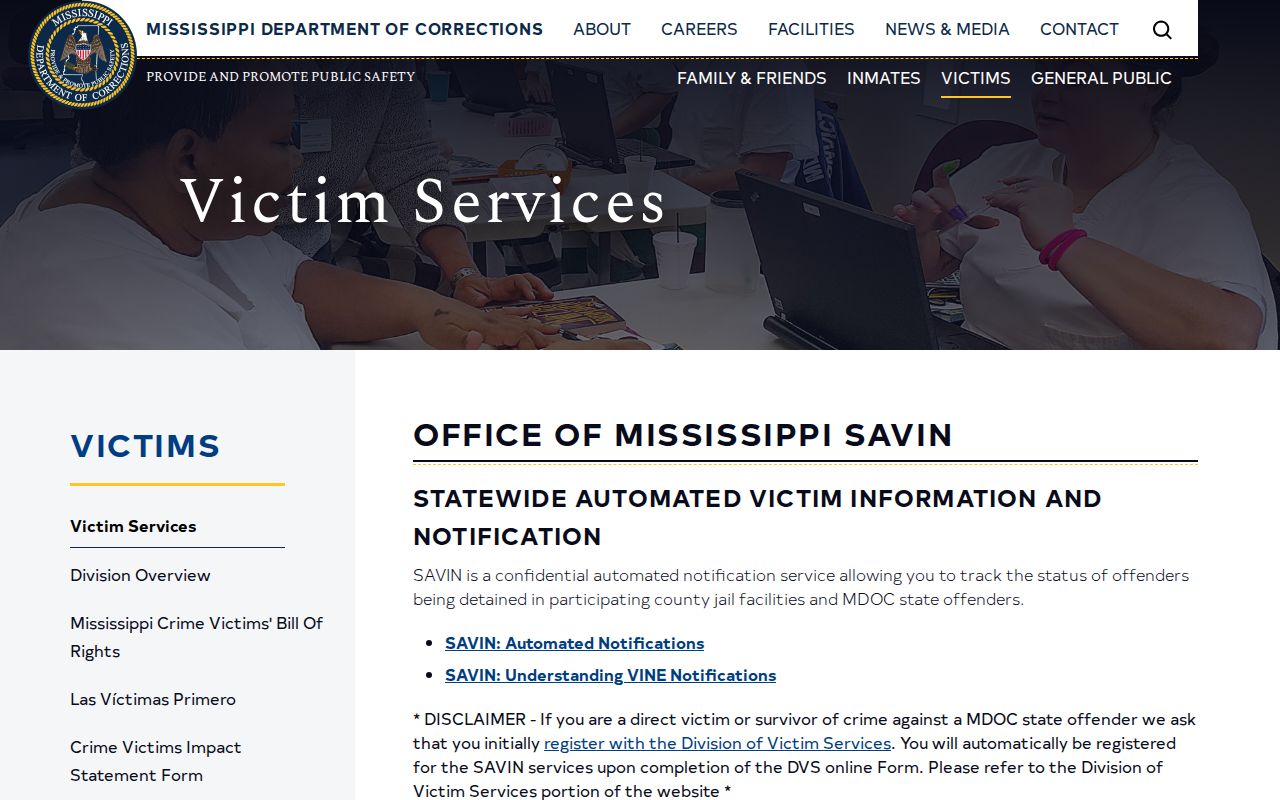
That state support layer is where a user can resolve an alert that does not match the source agency’s current record.
Chickasaw SAVIN Registration Link
Mississippi SAVIN has a distinctive “Registration Link.” It can preserve a notification registration when a county-level offender is convicted and moves into MDOC or another covered custody setting. That continuity is especially useful in Chickasaw County because the regional facility mixes local and state correctional contexts.
The linked registration does not change the event’s meaning. A movement alert from county custody into MDOC is a transfer, not release into the community. Read the agency, event wording, and destination. Then search the MDOC ID and state record to learn the new location and sentence status.
The Mississippi SAVIN notifications page describes the registration link and the kinds of custody events that can trigger notices. Its manifest image below is matched to this VINELink release-check topic.
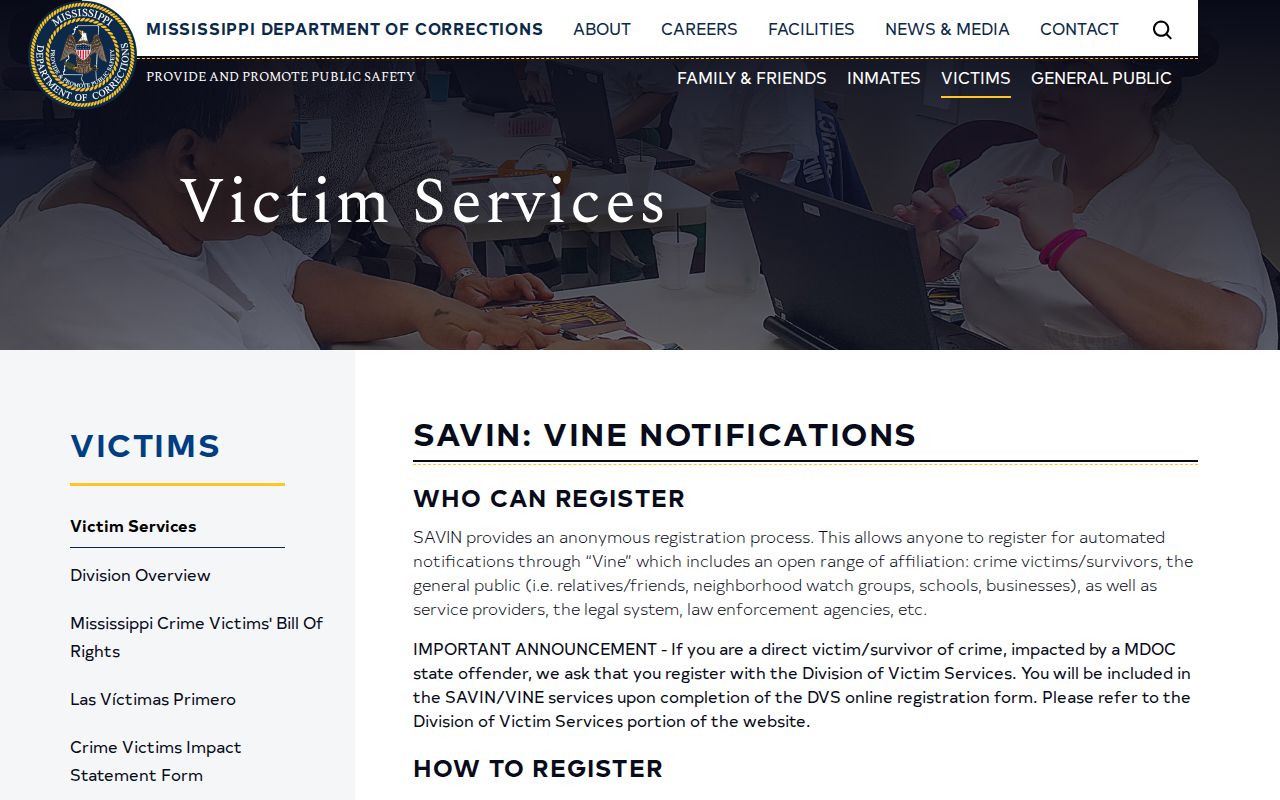
The image reinforces the local rule: carry the alert across agencies, but verify whether the event is transfer, conditional release, or final discharge.
Note: Mississippi’s Registration Link can preserve alerts across custody changes, yet it does not turn a transfer notice into community release.
Chickasaw VINELink Release Limits
VINELink does not cover federal Bureau of Prisons custody. Use the BOP Inmate Locator for a sentenced federal prisoner or former prisoner. A federal pretrial detainee may not appear in BOP’s sentenced-prison system, so the federal court and U.S. Marshals trail can matter. ICE also operates its own locator. A result in one system does not rule out custody in another.
Agency participation and data timing create other limits. A county result can lag the actual jail event. A person can be rehoused without release. Multiple notices can arise from electronic booking changes. A no-hit may be caused by agency nonparticipation or identity variation. VINELink should therefore trigger the next verification step rather than serve as the sole permanent record.
- County custody: ask the Chickasaw regional facility for release date, time, type, and authority.
- MDOC custody: compare the offender record, supervision status, and discharge certificate.
- Federal prison: use the BOP locator and the federal court or supervision record.
- ICE custody: use the ICE locator and direct confirmation within that system’s limits.
- Court outcome: match the case number to the bond, dismissal, sentence, or revocation order.
MS SAVIN is also not the Mississippi Sex Offender Registry. The registry covers only people with a qualifying conviction and registration duty. It is not a general list of released people, and it does not provide the Chickasaw County jail-release date.
Confirm Chickasaw VINELink Releases
Use the alert as a timely lead, then obtain the record that proves the event. For a local detainee, contact the Chickasaw County Regional Correctional Facility at 120 Lancaster Circle, Houston, MS 38851, or 662-456-3319. Ask for the booking-release entry tied to the person and the event window. Request the release authority and whether the event was a community exit or transfer.
For an MDOC prisoner, check the current offender record and determine whether the person moved to parole, ERS, another facility, or maximum discharge. A future tentative date is not an actual event. A discharge certificate is stronger evidence of executed release, while a Community Corrections record explains why a person remains under supervision outside the institution.
Finally, reconcile the court order. A bond or dismissal can explain a county release. A parole action can explain a state path, but a grant alone does not prove the person left that day. The custody event, court authority, and destination should tell one consistent story. If they do not, contact the source agencies and compare timestamps before drawing a conclusion.